When a manufacturer first looks at the Digital Product Passport, the opening question is almost always about data: which fields will we have to provide? It is a fair question. Another one comes before it, though, and that is the one which decides the budget: at what level does the passport apply?
Three possible answers, and a gap of one to several thousand between them.
What the regulation says
The EU Ecodesign Regulation provides that the digital product passport should be specific to the item, batch or model of product. Each word has a precise meaning. The model covers versions sharing the same technical characteristics. The batch is a subset manufactured under given conditions. The item is the individual unit, the one a customer holds.
The essential point fits in one sentence: this level is not settled once and for all. It is decided category by category, in the delegated acts that will flesh out the regulation product family by product family.
The only category where the level is written today
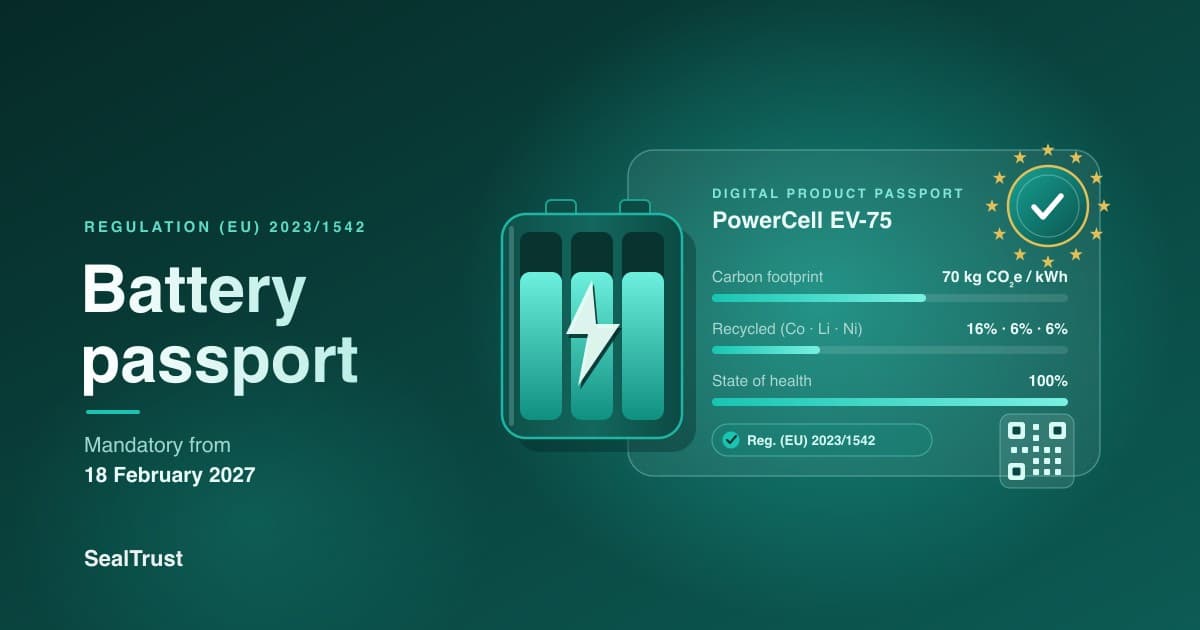
Batteries. The EU Batteries Regulation requires a passport from 18 February 2027, and it is explicit: every battery in scope carries its own. That is item level.
"In scope" is the operative phrase. It covers electric vehicle batteries, industrial batteries above 2 kWh, and light means of transport batteries. Portable batteries are excluded, and cordless power tools with them. A maker of cordless drills does not face that deadline, however often it is presented as theirs.
For other families, the level will be decided later
Construction products fall under their own regulation, and its delegated act is not yet published. For electrical and electronic equipment, no act sets a passport at this stage.
Textiles are the next family on the calendar. The Commission plans to adopt their delegated act in the fourth quarter of 2027, and says itself that this timeline may evolve. Under Article 4(4) of the ESPR, such an act applies, as a rule, no earlier than 18 months after it enters into force: around mid-2029 at the earliest. The study the European Commission's Joint Research Centre (JRC) published in May 2026 to prepare that act proposes the production batch as the minimum level for apparel, the item level remaining voluntary. It is a proposal, not the text.
That is precisely what makes upstream preparation worthwhile. Waiting for the text before starting means collecting data from your suppliers at the very moment the deadline lands, and it is that collection which takes months. What you prepare now keeps its value whatever level is chosen.
What the level changes, in volume
Take a catalogue of 3,000 references in continuous production.
| Level | Number of passports | What it implies |
|---|---|---|
| Model | 3,000 | one passport per reference, updated when the datasheet changes |
| Batch | as many as production runs | one passport per manufacturing batch, often tens of thousands a year |
| Item | your production volume | one passport per unit sold, potentially millions |
The carrier follows the same logic. At model or batch level, a code printed on the label is enough: the same code for the whole run, folded into the existing printing chain. At item level, every unit carries a unique identifier, which means individualised marking at the end of the line, and sometimes a chip.
Why getting it wrong is expensive
A manufacturer who assumes item level when the category will land on model over-sizes everything: unit marking, data volume, storage cost, collection effort. Many stop at that calculation and conclude compliance is out of reach. It is not. They costed the wrong assumption.
What holds whatever the level
Three things depend on no delegated act and can be prepared today.
Product identity. Being able to designate unambiguously what you are talking about, with a stable identifier that survives a catalogue reorganisation.
Structured data. Composition, origin, characteristics, in a format a machine can read, rather than in a PDF or a spreadsheet living on one workstation.
The data carrier. A durable carrier, readable by a phone, that stays with the product throughout its life.
Data first, carrier second
A passport is only worth the data it carries. Before choosing any carrier, product characteristics have to be complete, current and structured, which is a discipline of its own and a continuous effort rather than a one-off project.
That is the work of Marine Thauvin, founder of French Data Channel and a specialist in product data and the French Fab-Dis format, with whom we wrote this article in two voices: data quality on her side, identification and proof on ours.
At SealTrust we start from the same principle as with authentication: prepare what will still be true. A stable identifier, structured data, a durable carrier, and the passport level that the text applicable to your category will set. SealTrust serves all three levels: the model, the batch and the item. The model passport requires two things: a GTIN set on the model, which is the address that reaches it without a serial number, and a plan that includes the Digital Product Passport. The batch passport is attached to that model: it starts from the model's data, is read at the model's GTIN followed by the batch code, and a batch without a passport of its own stays covered by its model's. If the textile act keeps the batch level, as the JRC study proposes, that level is already available for apparel.