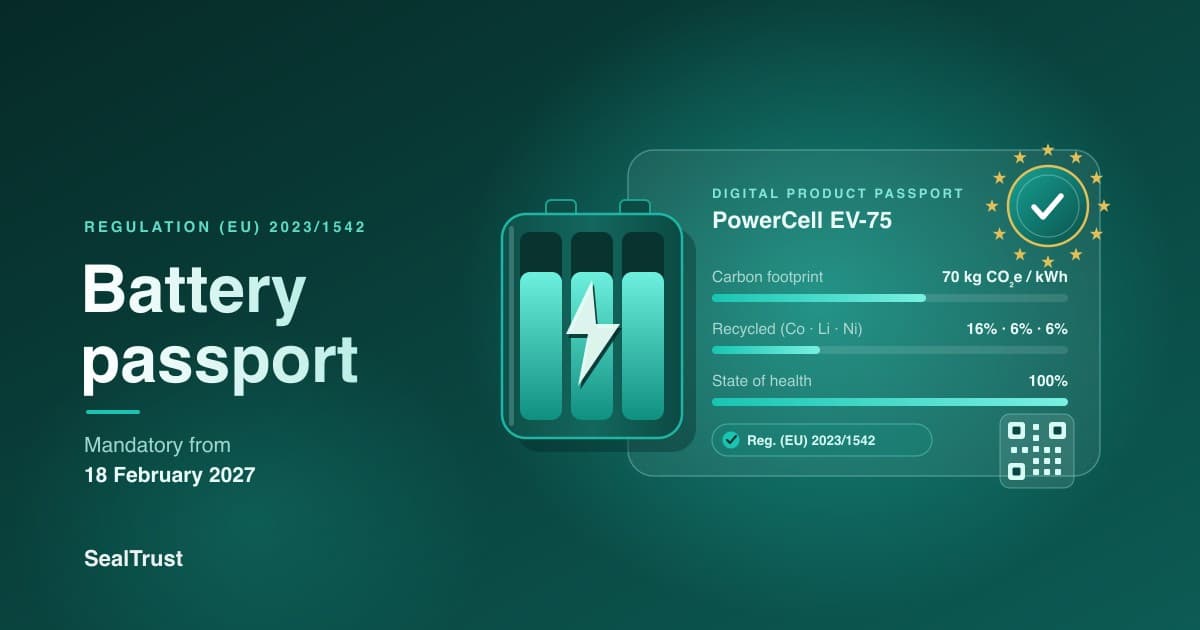
From 18 February 2027, any electric-vehicle battery, industrial battery above 2 kWh, or light-transport battery placed on the EU market will have to carry a digital passport. The obligation comes from Regulation (EU) 2023/1542, which is already in force. This is a real application date, and it is coming up fast.
Plenty of companies are only now looking into this, or mixing it up with other texts. This article sets out what the regulation actually asks for, and how to get ready without leaving it to the last minute.
Which batteries are covered
The passport does not apply to every battery. Three categories are in scope: electric-vehicle batteries, industrial batteries above 2 kWh, and light-transport batteries (e-bikes and e-scooters, among others).
Portable batteries and SLI (automotive starter) batteries are left out. They still face other obligations (carbon footprint, recycled content, labelling) but there is no passport to produce for them. Checking which category you fall into is the first thing to do; it saves you from putting resources into a product that is not concerned.
The data you need to provide
Annex XIII of the regulation lists the mandatory information. For the field names and their numbering, the reference is the European Commission's own guidance, Digital Batteries Passport — data points by category (v2.0, 15 August 2026), which lists 71 numbered data points. The information falls into a few families.
On identity, you have the passport identifier, the unique battery identifier, the economic-operator identifier, the category, the model, the mass and the status, which the regulation enumerates as ‘original’, ‘repurposed’, ‘re-used’, ‘remanufactured’ or ‘waste’.
On carbon footprint, the regulation asks for the total footprint per functional unit, kg of CO₂e per kWh over the service life, broken down across the four lifecycle stages (raw materials, manufacturing, distribution, end of life), together with a carbon performance class. One caveat matters for anyone planning: the Commission's guidance classifies the carbon footprint declaration and label as not to be filled or displayed as of February 2027, their format awaiting an implementing act.
On materials, you declare the chemistry, the critical raw materials, the hazardous substances, and the recycled content. That recycled share is asked for separately for cobalt, lithium, nickel and lead, and split between pre- and post-consumer.
On performance and durability, you report rated capacity, voltage, internal resistance, expected cycle count, and a set of parameters that change over time: remaining capacity, state of charge, state of health. These are fed by the battery management system.
A word on state of health (SoH). The regulation does not impose a single figure: it is computed from remaining capacity, capacity and power fade, and the rise in internal resistance. So the passport has to hold data that changes throughout the battery's life, not only at the point of market placement.
Who gets access to what
Not all of this data is public. The regulation sets out three levels of access: the public; persons with a legitimate interest (repairers, refurbishers, recyclers), alongside the Commission; and finally notified bodies and market surveillance authorities.
The precise definition of "legitimate interest" is left to an implementing act under Article 77(9): its 18 August 2026 deadline has passed without publication. Until it lands, the main thing to keep in mind is that your system will have to filter each piece of information according to who is looking at it, field by field rather than through a "legitimate interest" tier the text could later contradict. A consumer, a recycler and a regulator will not see the same record.
A mandatory QR code
The regulation requires a QR code (ISO/IEC 18004) that points to the passport and carries a unique identifier. To encode that identifier, the GS1 Digital Link standard (ISO/IEC 18975:2024) is the front-runner, even if it has not yet been fixed in law.
For a battery, the QR code is enough and costs little. The question of the carrier looks different when the physical authenticity of the product is at stake (in luxury goods, say, or on sensitive parts) where a secure NFC seal adds protection against counterfeiting. The choice is made product by product.
The electronics question
On consumer electronics, let's be clear: no ESPR delegated act creating a passport exists to date. The ESPR framework regulation (EU) 2024/1781 lays the groundwork (product, operator and facility identifiers, a central DPP registry in service since 20 July 2026) but electronics is only handled horizontally in the 2025-2030 working plan, with a repairability measure targeted for around 2027 and recyclability around 2029.
What does already apply is Ecodesign Regulation (EU) 2023/1670 on smartphones and tablets, in force since 20 June 2025: a battery that lasts at least 800 cycles at 80 % of its capacity, spare parts available for at least seven years, updates for at least five years, and an A-to-E repairability class on the label. In France, the repairability index (2021) and then the durability index (2024-2025) already require transparency on the repairability of several equipment categories.
For electronics, the sensible stance is to build on the ESPR framework and the existing Ecodesign rules, rather than trying to guess at fields that have not been defined yet.
SCIP and EPREL: don't duplicate what already exists
Two European databases intersect with the passport. The first, SCIP, run by ECHA, lists the substances of concern contained in articles; each notification receives a unique number. Because the passport's "substances of concern" fields (ESPR Article 7.5) overlap with SCIP's, that number acts as the link between the two. The second, EPREL, is the energy-label registry: each model gets a registration number there, and for an energy-labelled product, EPREL can feed the passport directly.
ESPR actually plans to link the passport explicitly to both databases. Rather than re-entering this data, it is better to reference it.
What SealTrust does
We built our digital product passport platform around these requirements. It handles identifiers and the data carrier: GS1 Digital Link, QR code or NFC depending on the product, and a public resolver. It exports the data as JSON-LD, using the Schema.org, GS1 and ESPR vocabularies, from per-product templates, including a battery template whose fields carry the Commission guidance's own data-point numbers alongside their Annex XIII legal basis, and an electronics template.
Each passport can be issued as a verifiable credential (SD-JWT-VC) anchored on a did:web and signed by a key held in a security module, which makes it verifiable even offline and after a key rotation. Field access is filtered field by field across six profiles: anonymous public, end user, repairer, recycler, upstream and market surveillance authority. They are audiences with different needs, not increasing levels of clearance: a recycler is not above a repairer, and none of the three trades sees what its neighbour adds. The accreditations you grant a partner are repairer and recycler; the upstream profile stays with your own team and with an authority. We build the EU central registry record and the JSON or XML file the registry ingests, at most one hundred records per file, and you can review it in full before anything is sent. You upload it yourself, because the deposit requires a verified economic operator and a qualified electronic seal that only you hold. Our own field names stand in until the Commission publishes the semantic catalogue. The passport carries the SCIP notification number and the EPREL registration number when you supply them, which is what links it to those two databases.
The idea fits in one sentence: turn the regulatory text into data that is issued, signed and consultable, without having to rebuild your information system.
Where to start
Start by scoping it: do your batteries fall under the passport (EV, industrial above 2 kWh, light transport)? Do your electronics already come under Ecodesign 2023/1670? Then gather the data that structures the file: carbon footprint per stage, recycled content per material, durability parameters. Choose the carrier (the QR code by default for batteries and electronics) and the access architecture. Finally, connect to the existing registries instead of copying their data.
The battery deadline falls on 18 February 2027. Companies that put their data in order now will reach 2027, and the ESPR steps that follow, in far better shape.
Preparing your battery or electronics passports? Get in touch.
Sources
- Regulation (EU) 2023/1542 (batteries), Annex XIII: eur-lex.europa.eu
- European Commission, Guidance Document: Digital Batteries Passport — data points by category, v2.0, 15 August 2026 (Ref. Ares(2026)7968977)
- Regulation (EU) 2024/1781 (ESPR): eur-lex.europa.eu
- ESPR 2025-2030 working plan: green-forum.ec.europa.eu
- Ecodesign for smartphones/tablets (EU) 2023/1670: single-market-economy.ec.europa.eu
- GS1 Digital Link / ISO/IEC 18975:2024: gs1.eu
- SCIP (ECHA): echa.europa.eu
- EPREL: energy-efficient-products.ec.europa.eu
- Repairability / durability index (France): ecologie.gouv.fr