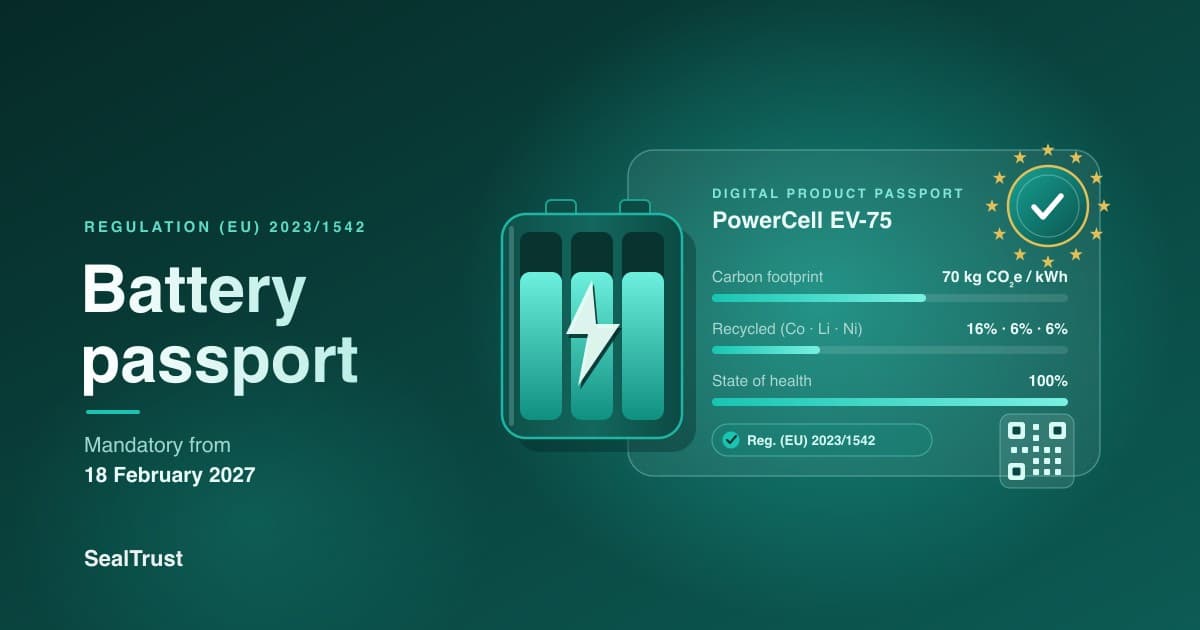
À partir du 18 février 2027, toute batterie de véhicule électrique, batterie industrielle de plus de 2 kWh ou batterie de transport léger mise sur le marché de l'UE devra comporter un passeport numérique. L'obligation découle du règlement (UE) 2023/1542, déjà en vigueur. L'échéance est bien réelle, et elle approche vite.
Beaucoup d'entreprises commencent tout juste à s'y intéresser, ou confondent ce texte avec d'autres. Cet article détaille ce que le règlement demande vraiment, et comment s'y préparer sans attendre la dernière minute.
Quelles batteries sont concernées
Le passeport ne s'applique pas à toutes les batteries. Trois catégories sont concernées : les batteries de véhicules électriques, les batteries industrielles de plus de 2 kWh et les batteries de transport léger (vélos et trottinettes électriques, notamment).
Les batteries portables et les batteries SLI (démarrage automobile) en sont exclues. Elles restent soumises à d'autres obligations (empreinte carbone, contenu recyclé, étiquetage), mais aucun passeport n'est à produire pour elles. Vérifier de quelle catégorie vous relevez est la première chose à faire ; cela vous évite d'investir des ressources dans un produit qui n'est pas concerné.
Les données à fournir
L'annexe XIII du règlement énumère les informations obligatoires. Pour le nom des champs et leur numérotation, la référence est le guide de la Commission européenne lui-même, Digital Batteries Passport — data points by category (v2.0, 15 août 2026), qui énumère 71 données numérotées. Ces informations se répartissent en quelques familles.
Pour l'identité, on trouve l'identifiant du passeport, l'identifiant unique de la batterie, l'identifiant de l'opérateur économique, la catégorie, le modèle, la masse et le statut, que le règlement énumère en cinq valeurs : ‘original’, ‘repurposed’, ‘re-used’, ‘remanufactured’ ou ‘waste’.
Pour l'empreinte carbone, le règlement demande l'empreinte totale par unité fonctionnelle (kg de CO₂e par kWh sur la durée de vie), ventilée sur les quatre étapes du cycle de vie (matières premières, fabrication, distribution, fin de vie), assortie d'une classe de performance carbone. Une nuance compte pour qui prépare l'échéance : le guide de la Commission classe la déclaration et le label d'empreinte carbone en « non renseignables au 18 février 2027 », leur format attendant un acte d'exécution.
Pour les matériaux, vous déclarez la chimie, les matières premières critiques, les substances dangereuses et le contenu recyclé. Cette part recyclée est demandée séparément pour le cobalt, le lithium, le nickel et le plomb, et distinguée entre pré- et post-consommation.
Pour les performances et la durabilité, vous renseignez la capacité nominale, la tension, la résistance interne, le nombre de cycles attendu, ainsi qu'un ensemble de paramètres évoluant dans le temps : capacité résiduelle, état de charge, état de santé. Ils sont alimentés par le système de gestion de la batterie.
Un mot sur l'état de santé (SoH). Le règlement n'impose pas une valeur unique : il se calcule à partir de la capacité résiduelle, de la perte de capacité et de puissance, et de la hausse de la résistance interne. Le passeport doit donc contenir des données qui évoluent tout au long de la vie de la batterie, et pas seulement au moment de la mise sur le marché.
Qui accède à quoi
Toutes ces données ne sont pas publiques. Le règlement prévoit trois niveaux d'accès : le public ; les personnes ayant un intérêt légitime (réparateurs, reconditionneurs, recycleurs), aux côtés de la Commission ; et enfin les organismes notifiés et les autorités de surveillance du marché.
La définition précise de l'« intérêt légitime » relève d'un acte d'exécution de l'article 77(9) : son échéance du 18 août 2026 est passée sans publication. Tant qu'il n'est pas publié, l'essentiel à retenir est que votre système devra filtrer chaque information selon la personne qui la consulte, champ par champ plutôt que par un palier « intérêt légitime » que le texte pourrait ensuite contredire. Un consommateur, un recycleur et un régulateur ne verront pas la même fiche.
Un QR code obligatoire
Le règlement impose un QR code (ISO/IEC 18004) pointant vers le passeport et portant un identifiant unique. Pour encoder cet identifiant, la norme GS1 Digital Link (ISO/IEC 18975:2024) tient la corde, même si elle n'est pas encore fixée dans la loi.
Pour une batterie, le QR code suffit et coûte peu. La question du support se pose différemment lorsque l'authenticité physique du produit est en jeu, dans le luxe par exemple ou sur des pièces sensibles, où un sceau NFC sécurisé ajoute une protection contre la contrefaçon. Le choix se fait produit par produit.
La question de l'électronique
Sur l'électronique grand public, soyons clairs : aucun acte délégué ESPR créant un passeport pour les équipements électriques et électroniques n'existe à ce jour. Le règlement-cadre ESPR (UE) 2024/1781 pose les bases (identifiants de produit, d'opérateur et d'installation, un registre central DPP en service depuis le 20 juillet 2026), mais l'électronique n'est traitée que de façon horizontale dans le plan de travail 2025-2030, avec une mesure de réparabilité visée vers 2027 et de recyclabilité vers 2029.
Ce qui s'applique déjà, c'est le règlement Écoconception (UE) 2023/1670 sur les smartphones et tablettes, en vigueur depuis le 20 juin 2025 : une batterie tenant au moins 800 cycles à 80 % de sa capacité, des pièces détachées disponibles au moins sept ans, des mises à jour pendant au moins cinq ans, et une classe de réparabilité de A à E sur l'étiquette. En France, l'indice de réparabilité (2021) puis l'indice de durabilité (2024-2025) imposent déjà la transparence sur la réparabilité de plusieurs catégories d'équipements.
Pour l'électronique, la position raisonnable est de s'appuyer sur le cadre ESPR et les règles Écoconception existantes, plutôt que d'essayer de deviner des champs qui n'ont pas encore été définis.
SCIP et EPREL : ne pas dupliquer l'existant
Deux bases de données européennes recoupent le passeport. La première, SCIP, gérée par l'ECHA, recense les substances préoccupantes contenues dans les articles ; chaque notification reçoit un numéro unique. Comme les champs « substances préoccupantes » du passeport (ESPR article 7.5) recoupent ceux de SCIP, ce numéro fait le lien entre les deux. La seconde, EPREL, est le registre de l'étiquette énergétique : chaque modèle y reçoit un numéro d'enregistrement, et pour un produit étiqueté énergie, EPREL peut alimenter directement le passeport.
L'ESPR prévoit d'ailleurs de lier explicitement le passeport à ces deux bases. Plutôt que de ressaisir ces données, mieux vaut les référencer.
Ce que fait SealTrust
Nous avons conçu notre plateforme de passeport numérique de produit autour de ces exigences. Elle gère les identifiants et le support de données : GS1 Digital Link, QR code ou NFC selon le produit, et un résolveur public. Elle exporte les données en JSON-LD, à partir des vocabulaires Schema.org, GS1 et ESPR, depuis des gabarits par produit, dont un gabarit batterie dont les champs portent le numéro officiel de chaque donnée du guide de la Commission, à côté de sa base légale à l'annexe XIII, et un gabarit électronique.
Chaque passeport peut être émis sous forme d'attestation vérifiable (SD-JWT-VC) ancrée sur un did:web et signée par une clé conservée dans un module de sécurité, ce qui le rend vérifiable même hors ligne et après une rotation de clé. L'accès aux champs est filtré champ par champ selon six profils : public anonyme, utilisateur final, réparateur accrédité, recycleur accrédité, amont et autorité de surveillance du marché. Ce sont des publics aux besoins différents, pas des niveaux d'habilitation croissants. Nous construisons l'enregistrement pour le registre central de l'UE, ainsi que le fichier JSON ou XML qu'il ingère, découpé à cent enregistrements par fichier, et vous pouvez le relire en entier avant tout envoi. Vous le téléversez vous-même, parce que le dépôt exige un opérateur économique vérifié et un cachet électronique qualifié que vous seul détenez. Les noms de champs restent les nôtres tant que la Commission n'a pas publié le catalogue sémantique. Le passeport porte le numéro de notification SCIP et le numéro d'enregistrement EPREL quand vous les renseignez, ce qui fait le lien avec ces deux bases.
L'idée tient en une phrase : transformer le texte réglementaire en données émises, signées et consultables, sans avoir à refondre votre système d'information.
Par où commencer
Commencez par délimiter le périmètre : vos batteries relèvent-elles du passeport (VE, industrielles de plus de 2 kWh, transport léger) ? Votre électronique relève-t-elle déjà de l'Écoconception 2023/1670 ? Rassemblez ensuite les données qui structurent le dossier : empreinte carbone par étape, contenu recyclé par matériau, paramètres de durabilité. Choisissez le support (le QR code par défaut pour les batteries et l'électronique) et l'architecture d'accès. Enfin, connectez-vous aux registres existants au lieu de copier leurs données.
L'échéance batteries tombe le 18 février 2027. Les entreprises qui mettent leurs données en ordre dès maintenant aborderont 2027, et les étapes ESPR suivantes, en bien meilleure posture.
Vous préparez vos passeports batterie ou électronique ? Contactez-nous.
Sources
- Règlement (UE) 2023/1542 (batteries), annexe XIII : eur-lex.europa.eu
- Commission européenne, Guidance Document: Digital Batteries Passport — data points by category, v2.0, 15 août 2026 (réf. Ares(2026)7968977)
- Règlement (UE) 2024/1781 (ESPR) : eur-lex.europa.eu
- Plan de travail ESPR 2025-2030 : green-forum.ec.europa.eu
- Écoconception des smartphones/tablettes (UE) 2023/1670 : single-market-economy.ec.europa.eu
- GS1 Digital Link / ISO/IEC 18975:2024 : gs1.eu
- SCIP (ECHA) : echa.europa.eu
- EPREL : energy-efficient-products.ec.europa.eu
- Indice de réparabilité / durabilité (France) : ecologie.gouv.fr