There was a time when spotting a fake luxury handbag was easy. The stitching was off, the leather felt wrong, the logo was slightly crooked. Those days are over. Counterfeiting has become a sophisticated industrial operation, and it now costs the global economy an estimated $467 billion every year, according to the OECD and the European Union Intellectual Property Office (EUIPO). For the major luxury groups (LVMH, Kering, Richemont) the losses run into billions of euros annually. But beyond the money, there's a deeper problem: when consumers can no longer tell what's real, the very idea of luxury starts to crumble.
The Numbers Tell a Stark Story
Consider this: international trade in counterfeit and pirated goods now accounts for 2.5% of global merchandise trade (OECD/EUIPO), and customs agencies intercept only a small fraction of the actual flow. Leather goods, watches, high-end clothing, these are consistently among the most targeted categories. The European fashion and luxury sector loses an estimated over €16 billion per year in direct revenue to counterfeiting (EUIPO 2024), not counting the quieter damage to brand reputation and the mounting legal bills.
E-commerce has supercharged the problem. Over 60% of counterfeit distribution now happens through online marketplaces and social media, according to the International Chamber of Commerce. And here's what's truly sobering: a 2023 study by Entrupy found that more than one in three buyers who purchased a luxury item on a secondary market unknowingly ended up with a counterfeit. They thought they were getting a deal. They were getting deceived.
Why Holograms and QR Codes No Longer Cut It
Traditional authentication methods (holograms, printed serial numbers, security labels, paper certificates) all share the same fundamental weakness: they can be visually copied. It sounds simple, because it is. Even high-security holograms, the ones with multiple layers and shifting colors, are now being replicated with alarming fidelity by workshops equipped with professional-grade tools. Static QR codes? A screenshot is all it takes to duplicate one. Paper certificates? Counterfeited at scale, sometimes with quality that surpasses the originals.
There's another problem with these approaches: they rely on centralized databases controlled by individual brands. That creates a single point of failure, one that can be hacked, manipulated, or simply go offline. And for the consumer? There's no way to independently verify anything. You're asked to trust the brand's word, with no recourse if that trust is misplaced.
What Blockchain Brings to the Table
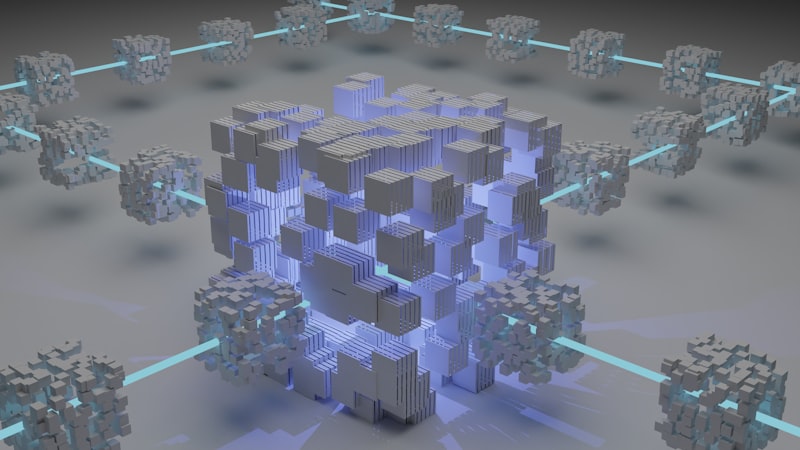
Blockchain changes the equation by introducing something that didn't exist before in authentication: a distributed ledger that is immutable and publicly verifiable. Here's what that means in practice. Each luxury product gets a unique digital certificate, a non-fungible token (NFT) built on established blockchain standards. This token is deployed on a blockchain chosen for its low transaction fees, fast confirmations, and minimal environmental footprint (it uses proof-of-stake, not the energy-hungry proof-of-work).
The product's provenance data (where it was made, by whom, with what materials, what quality checks it passed) gets permanently stored on IPFS, a decentralized storage protocol. Nothing can be quietly deleted or altered. Every transaction in the product's life, from its creation to every subsequent resale, is transparently recorded and timestamped.
LVMH pioneered this approach with its Aura Blockchain consortium back in 2021. Richemont has invested heavily in traceability for its watch brands. The reason is straightforward: a certificate of authenticity is no longer a piece of paper that can be lost or forged. It's a mathematical fact, recorded in a ledger that no single party controls.
NFC: The Bridge Between Physical and Digital
Blockchain alone isn't enough, though. You still need an unbreakable link between the physical product and its digital identity. That's where advanced cryptographic NFC technology comes in.
What makes cryptographic NFC chips different from ordinary NFC tags is their secure dynamic messaging capability. Every time someone scans the tag, it generates a unique encrypted message incorporating a read counter and an authentication code derived from cryptographic keys that are unique to that specific tag. Even if an attacker intercepted a response, it would be valid for exactly one scan. Cloning becomes physically impossible.
For the consumer, the experience couldn't be simpler. Hold your smartphone near the product (a bag, a watch, a bottle of wine) and in under two seconds, you see the complete provenance: blockchain certificate, ownership history, manufacturing details, and cryptographic confirmation that the tag is genuine. No apps to download, no experts to consult, no waiting.
The tag itself is thinner than 0.3 mm. It slips into labels, linings, packaging, or directly into the product without affecting aesthetics or manufacturing. For fashion houses under Kering (Gucci, Saint Laurent, Balenciaga) and for Richemont's watchmakers, integration takes days and fits naturally into existing production lines.
The Return Goes Far Beyond Anti-Counterfeiting
The economic case for blockchain-NFC authentication extends well beyond fighting fakes. The benefits compound across three fronts: anti-counterfeiting, secondary-market value, and a direct digital relationship with the owner.
Brands that have deployed these technologies report measurable outcomes across several fronts. On the secondary market, certified resale platforms like Vestiaire Collective and The RealReal value items with a blockchain certificate significantly higher, with resale premiums estimated between 15% and 25%. Each NFC scan also becomes a direct touchpoint between brand and owner, an opportunity for personalized services, maintenance reminders, or invitations to exclusive events. And the anonymized scan data provides insights that brands have never had before: where products are used, how often they're verified, and what the ownership journey looks like.
With Bain & Company estimating the luxury resale market will reach over €50 billion by 2027, brands that secure their secondary market through blockchain today are positioning themselves to capture a significant share of that value.
How Deployment Works in Practice
Rolling out a SealTrust authentication solution follows four stages. First, secure initialization: each cryptographic NFC tag is programmed with unique cryptographic keys generated via a hardware security module. Second, production integration: tags are embedded at the finishing stage and scanned at end-of-line to automatically mint the digital certificate on the blockchain. Third, activation: at first sale, the certificate transfers to the owner through a simple interface, no crypto wallet or technical knowledge required. Fourth, lifecycle management: every resale, every repair, every verification is recorded on-chain, building a provenance history that's as detailed as an automotive service record, but impossible to tamper with.
For multi-brand groups, SealTrust provides a unified dashboard to manage all brands from one place, with real-time analytics, counterfeiting alerts, and performance tracking by product, region, and channel.
Authentication as Strategic Advantage
Counterfeiting is a half-trillion-dollar problem, and the traditional tools have failed to contain it. The convergence of hardware cryptography, distributed ledgers, and decentralized storage is the first technological response that's genuinely up to the challenge. For luxury houses, this is no longer optional. Consumer expectations have shifted, the European Digital Product Passport arrives in 2027, and the resale market is growing too fast to leave unprotected.
SealTrust supports brands through this transition with a turnkey solution, deployable in days, without disrupting what already works. From the workshop to the consumer's smartphone, every product gets a digital identity that can't be forged, can't be faked, and won't fade over time.
Want to see this on a real product? We can ship you a demo kit with pre-provisioned NTAG 424 DNA tags. Scan one, see the blockchain certificate, judge for yourself. Request a kit.